

There is a point in almost every supplement launch when the packaging finally feels finished. The formula has been approved, the bottle looks right, the branding is polished, and the team is ready to start talking to buyers.
That is also the moment when a small labeling mistake can become surprisingly expensive.
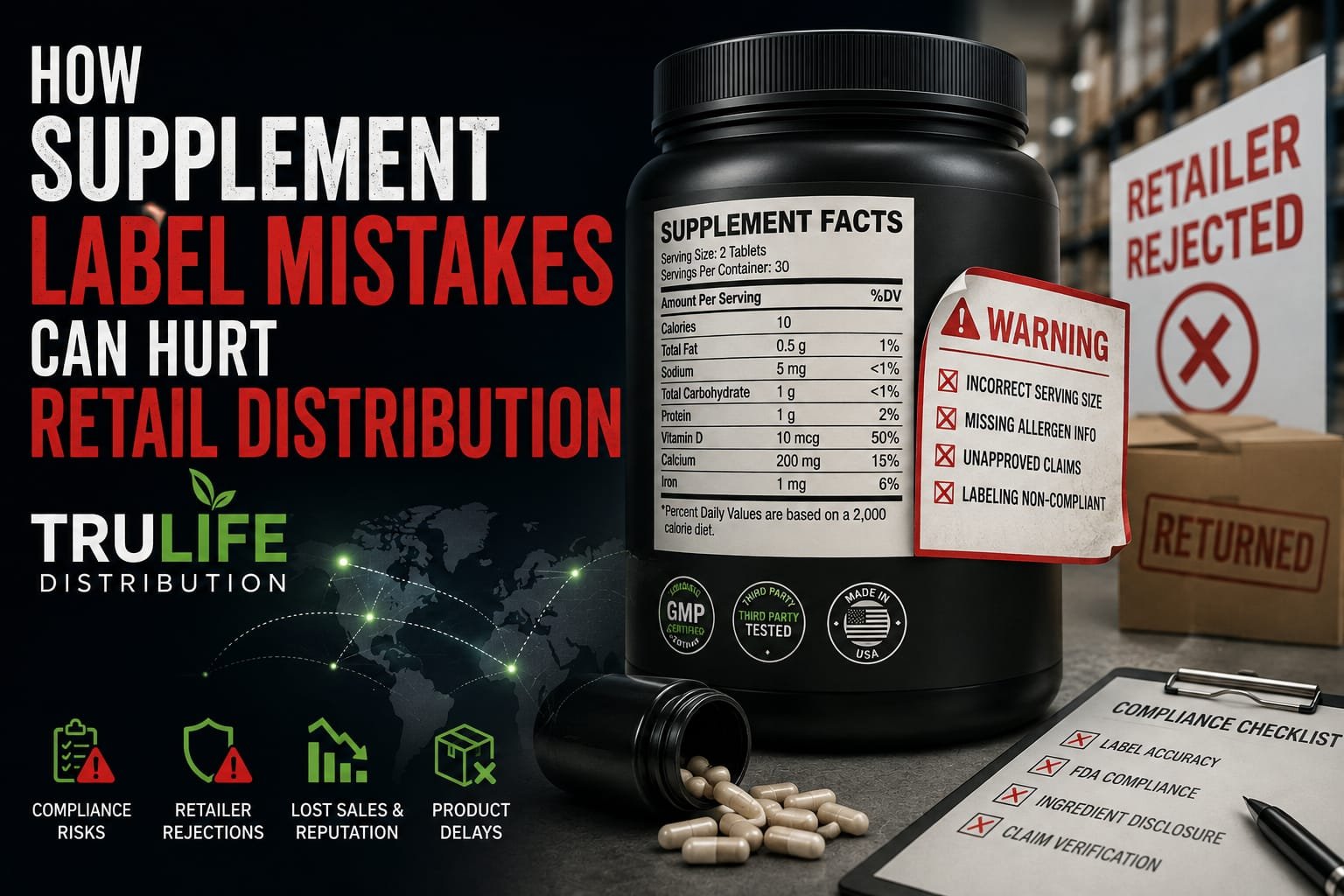
For a supplement brand entering the United States, the label is more than packaging. It is part of the product’s regulatory identity and, just as importantly, part of its retail distribution readiness. FDA’s dietary supplement labeling guidance applies to both domestic and foreign-produced supplements, and FDA generally does not approve supplement labeling before the product reaches the market. The business placing the supplement into commerce is responsible for ensuring that the product is not misbranded or otherwise in violation of federal law.
That is why TruLife Distribution includes FDA label compliance and claims review among the services it provides to brands preparing for the U.S. market. The idea is straightforward: find problems while they are still inexpensive to correct, not after packaging has been printed and a retail launch is already moving forward.
When a Label Problem Becomes a Retail Distribution Problem
Labeling is often treated as a regulatory issue sitting somewhere outside sales. In practice, the two are closely connected.
A retailer does not see a formula in a laboratory. It sees the finished product that will be placed in front of consumers. If the product identity is unclear, required information is missing, a claim creates regulatory concerns, or the label does not properly communicate what is inside the bottle, the problem reaches beyond compliance.
It can affect whether the product is ready to sell at all.
FDA can take action against dietary supplements that are adulterated or misbranded after they reach the marketplace. For a brand trying to establish retail distribution, that makes early label review part of protecting the wider launch rather than simply checking a regulatory box.
The most frustrating part is that many of these problems are preventable.
A label can look professional and still be wrong.
The Label Has to Match the Product, Not Just the Brand Design
Supplement packaging is usually developed by people who understand branding. They know how to make a bottle look premium, how to create hierarchy on the front panel, and how to fit a large amount of information into a limited space.
Compliance asks a different set of questions.
Does the product have the correct statement of identity? Is the net quantity properly presented? Does the Supplement Facts panel accurately reflect the product? Are ingredients declared appropriately? Is the required business information present?
FDA’s dietary supplement labeling framework addresses these areas specifically, which is why a visual review alone is not enough.
This becomes even more important when an established brand is adapting packaging originally created for another country.
The temptation is to preserve the design at all costs and squeeze U.S. requirements into whatever space remains. A better approach is to establish what the American label needs first and then make the design work around it.
That may sound like a small change in process, but it can prevent major rework later.
Claims Can Turn Good Marketing Copy Into Regulatory Risk
A supplement brand naturally wants its packaging to explain why the product matters.
That is where another common problem begins.
Marketing teams are trained to make benefits sound stronger, simpler and more memorable. Dietary supplement claims, however, do not operate without boundaries. FDA distinguishes between different types of claims, including structure/function claims and disease-related claims, and those distinctions can materially change how a statement is treated.
A structure/function claim may describe how an ingredient supports a normal structure or function of the body, but qualifying claims must be truthful and not misleading, need appropriate substantiation and are subject to specific notification and disclaimer requirements.
That means copy should not be approved simply because it sounds persuasive.
The question is not only, “Will this help sell the product?”
It is also, “Can this claim be properly supported and used in this context?”
TruLife Distribution lists claims and regulatory review as part of its international services, specifically reviewing marketing claims for compliance with U.S. federal requirements.
For brands entering American retail, that review is far more useful before packaging is printed than after a problem has already been built into finished inventory.
Why an Overseas Label Usually Needs More Than a Translation
A company can have a successful supplement brand outside the United States and still need meaningful packaging changes before pursuing U.S. retail distribution.
That does not mean the original market got anything wrong.
It simply means the product was prepared for a different regulatory environment.
FDA explicitly states that its dietary supplement labeling guidance also applies to supplements produced in foreign countries for the U.S. market.
A literal translation therefore cannot be the entire market-entry strategy.
The formula, ingredient declarations, claims, panel information and other label elements need to be considered in the context of U.S. requirements. Brands also have to think about whether the language makes sense to an American consumer and whether the product can be presented clearly enough for retail buyers to understand where it belongs.
TruLife’s published international services include FDA label compliance review, product-line evaluation and claims review, all of which are relevant before a foreign supplement brand begins pushing deeper into the U.S. retail market.
That is a more useful process than discovering after production that an existing package does not travel as easily as the product itself.
Retail Distribution Starts Before the Buyer Ever Sees the Product
Brands often think about retail distribution in terms of the final stages: buyer meetings, purchase orders and getting onto shelves.
The stronger launches start earlier.
Before a buyer sees a supplement, the company should already know that the product can be properly presented in the United States. The label should make sense. Claims should have been reviewed. The brand should understand its market position and have a credible route into the retail channel.
TruLife’s international-services model connects those early compliance steps with the larger U.S. market-entry process. Its site lists label compliance, claims review, product evaluation, importation assistance, customs support and connections to retail distribution channels among its services.
That sequence matters.
If a company secures buyer interest before resolving basic product-readiness issues, the sales opportunity can arrive ahead of the business.
By contrast, when the label and regulatory groundwork are addressed early, retail discussions can focus on the things they are supposed to focus on: the product, the category opportunity, the consumer and the commercial potential.
Where TruLife Distribution Fits Into the Label-Readiness Process
The name TruLife Distribution can make it easy to assume that the company simply receives products and resells them.
That is not the role being discussed here.
TruLife’s own site describes a broader service model for nutrition, health, wellness, skincare and beauty brands entering or expanding in the United States. Its international offering includes compliance work as well as support around importation, marketing, sales and distribution.
For supplement labels specifically, the relevant role begins with helping a brand assess whether the product is ready for the U.S. environment.
That can include reviewing FDA label compliance and examining marketing claims against U.S. requirements.
The distinction is important because a service-based distribution partner should be helping the client’s brand become market-ready, not behaving as though the product has become its own inventory or its own brand.
For companies coming into America from abroad, that kind of support can fill a practical gap between having a finished supplement and having a product prepared for the realities of U.S. retail distribution.
The Costliest Label Mistake Is Often Reviewing It Too Late
Consider the same labeling problem at two different stages.
In the first case, the product is still in artwork. Someone catches the issue, the designer makes a correction, and a new proof is produced.
In the second case, thousands of units already exist.
The same mistake now sits on every bottle.
Nothing about the original error has changed, but the cost of solving it has.
That is the real business argument for reviewing supplement labels early. Compliance work is not there to make a launch slower. Done at the right time, it can help prevent avoidable delays later.
For TruLife clients moving toward American retail distribution, label compliance review sits naturally before the point where large commitments have already been made. TruLife specifically lists this review as part of helping manufacturers meet U.S. federal regulations and industry standards.
It is much easier to correct a label while the product is still being prepared than to build an entire commercial plan around packaging that was never fully ready.
A Better Retail Launch Begins With a Label the Brand Can Stand Behind
A strong supplement deserves more than attractive packaging.
It needs packaging that accurately represents the product, communicates appropriately with consumers and supports rather than complicates the brand’s move into American retail.
That is why label preparation belongs inside the retail distribution conversation.
It affects how the product enters the market, how it is presented, and whether avoidable compliance problems appear at the worst possible moment.
For TruLife Distribution, the relevant role is clear: help brands address U.S. label compliance and regulatory claims as part of preparing them for the wider American market.
The company does not need to be mentioned in every paragraph for that connection to make sense. The value is in understanding where its services matter most.
A label should never be the most exciting part of a supplement launch.
But if it is wrong, it can quickly become the part everyone is talking about.
Getting it right early gives the brand a much better chance to focus on what comes next: building credible, sustainable retail distribution in the United States.
